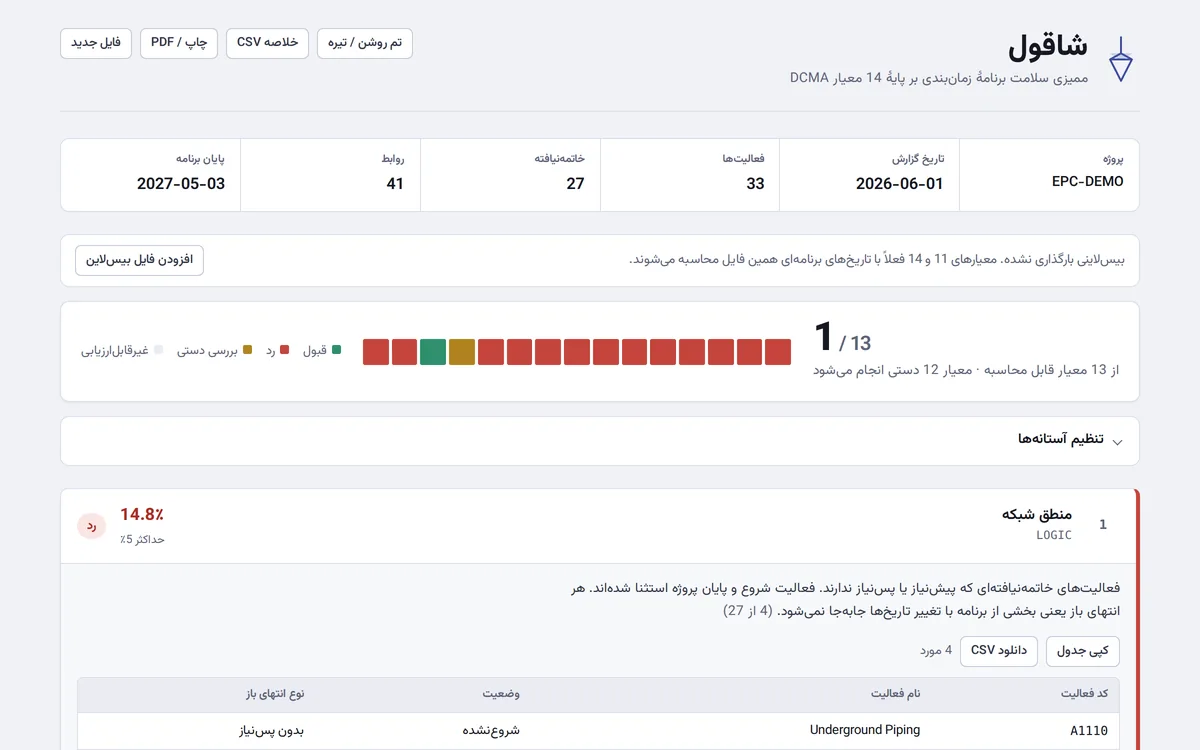
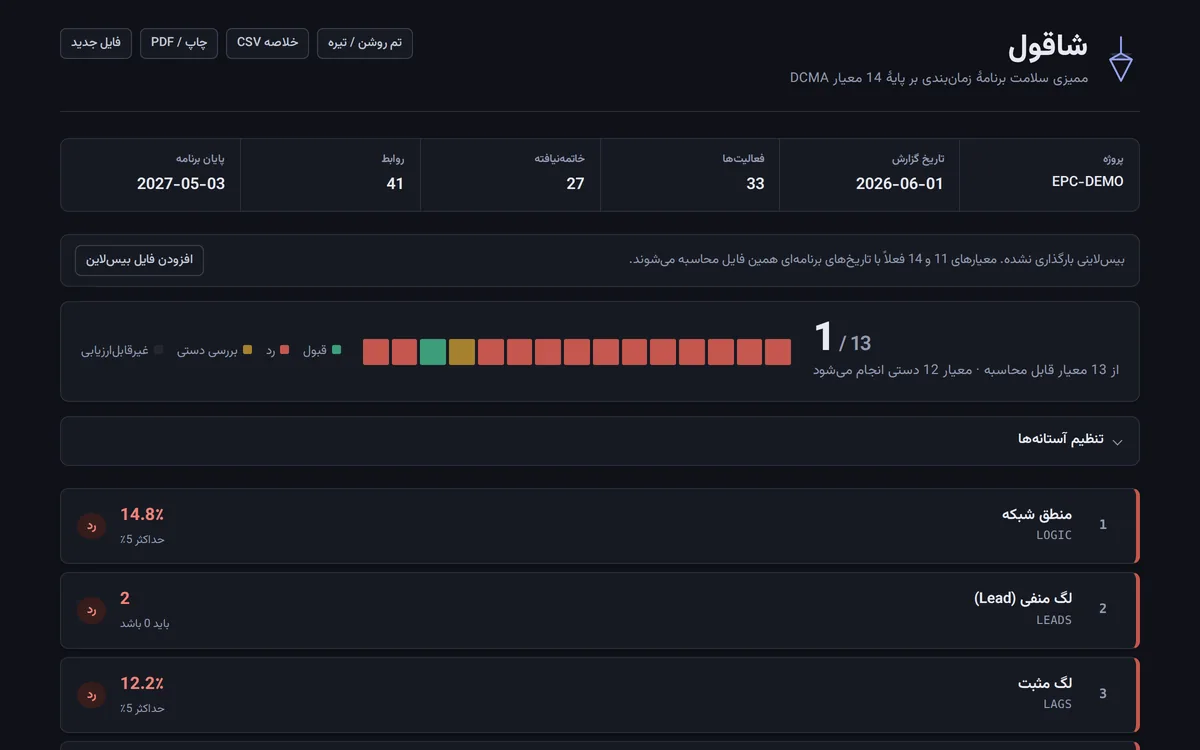
A schedule health audit that never sees your schedule.
Shaghool reads a Primavera P6 XER export and returns the DCMA 14-point schedule assessment with the offending activities named, one by one. A licence unlocks the browser tool; after the engine arrives, the schedule never leaves the machine it is opened on.
Licence / direct purchase
Use the report on your next P6 update.
Choose a licence period, review the exact price, then continue to the manual-transfer checkout.
Monthly licence price$19.00
Licence period
Input
Primavera P6 XER
Scope / output
12 automated + 2 manual verifications
File privacy
XER analysis stays in this browser after licence verification.
Why does schedule assurance stay manual when the checks are entirely mechanical?
Every DCMA criterion is a countable property of the file: relationships without a predecessor, negative lags, hard constraints, float above a threshold. Planners still work through them by hand or buy a five-figure desktop licence. And the tools that do automate it are cloud services, which rules them out for anyone whose contract, employer, or jurisdiction forbids uploading a programme.
Key product decisions
01
Parse in the browser, not on a server
The XER parser is JavaScript running on the page. After a licence unlocks the engine, there is no upload endpoint — the schedule stays on the machine. Updates are automatic: every time you open the tool you get the current version.
02
Name the activities, not just the score
A percentage tells a planner they failed; a list tells them what to fix. Every criterion expands into the exact activities or relationships that triggered it, exportable as CSV.
03
Say what cannot be measured
Criterion 12, the critical path test, needs the schedule to be recalculated with an injected delay. The tool cannot do that from a file, so it says so and explains how to run the test in Primavera rather than inventing a result.
04
Built for Persian first
Right-to-left brought real bugs: the comparison symbol in a threshold is mirrored by the bidi algorithm and silently inverts its meaning, and negative floats render back to front. Both are fixed, and dates can be shown in the Jalali calendar.
Current outcome
Current outcome
The tool automates 12 of the 14 checks plus an out-of-sequence progress check. The critical-path reschedule test and formal CPLI verification remain manual; the displayed CPLI estimate is excluded from the pass score. An optional baseline supports missed-activity and BEI measurements. Multi-project selection, per-check CSV, summary CSV and print are included. Regression tests use synthetic schedules and hand-counted expected results; results still require project-specific review.
My role
Product definition, schedule-domain logic, XER parsing, interface design, and verification.
Next step
A licence unlocks the browser tool, updates, and support. Qiyas, the two-file weekly comparer, is the next module and is now available. A written human review of one programme is also available if you want findings, not just a score.